Selected Projects
Reclaim Hosting
 Reclaim Hosting provides educators an easy way to offer their students domains and web hosting that they own and control. The goal of Reclaim is to help make the process of offering a flexible web space and domain name to faculty, students, and staff as easy and cheap as possible. What’s more, unlike most commodity hosting, this service is supported by a community of educators and educational technologists. We use our combined expertise of understanding educational environments and their technology needs to provide an advanced hosting framework in the spirit of the Domain of One’s Own project.
Additionally, Reclaim is rooted in the idea that students, faculty, courses, departments, and/or institutions of higher education that want to experiemnt with web hosting in an educational community can benefit from the work already done, so that together we can create a broader community for integrating the web as platform for teaching and learning in higher education.
Link to a post on bavatuesdays about the "The Long Short History of Reclaim Hosting."
OERxDomains21
 In 2021 as the world was in a global lock-down, Reclaim Hosting partnered with Association for Learning Technology to design and run the OER Conference as a shared online event that would be known as OERxDomains21. This conference was notable for trying to escape an extension of the Zoom malaise so many events had succumbed to during that period. Creating a truly engaging online event that marries both pre-recorded and live sessions embedded within an engaged community framework was no small feat.
Our goal was to try and re-create a sense of being there and “eventness” that face-to-face conferences often can manage by using space and time to create a shared sense of attention. The people that were part of both the OER and Reclaim community made all the difference in terms of the event's success, but I also believe the design, centered around a conceit of community TV rather than a specific theme, provided the basis of a platform we created that enabled discussion, interaction, and engagement. You can hear more about the conception and execution of this event in our debrief discussion post conference.
Reclaim Arcade
 Reclaim Arcade is an operating retro arcade in Fredericksburg, Virginia that I helped conceptualize, design, and build between 2019 and 2022. Key design elements of the space, such as the 1980s living room and the "mom n' pop" VHS store, were based on previous projects I helped create and were integrated seamlessly to make this space truly one-of-a-kind.
While from the very beginning conceived as a profitable business (which it was), more than that Reclaim Arcade was a love letter to the media of another era. This project further reinforced my passion for the power of good design (both online and off), at the same time underscoring the importance of the history of technology to help inform where we are today and where we are going.
Link to a post on bavatuesdays contextualizing the explaining the idea of "Reclaim Arcade as Art".
UMW's Console Living Room
 My final project at UMW was in 2015 and in many ways the most personal. In collaboration with professor Zach Whalen we created a 1980s living room within the then brand-new, state of the art IT Convergence Center. The space was open to the public and included all the period-appropriate furniture and media, including panelled walls, patterned coaches, faux-wood TVs, top-loading VCRs, broadcast TV, and various video game consoles---all of which we invited visitors to use freely.
The living room recalls and reenacts the domestic convergence of consumer media technology. By making these games and appliances available in a public space, we were inviting students, guests, and the community to visit and interact with an earlier time. The 80s living exhibit was shit down after a few months, but the idea would be reincanated for Recllaim Arcade.
Link to bavatuesdays post contextualizing the project titled "UMW's Console Living Room: There is Something that Loves a Paneled Wall.
A Domain of One’s Own
 A Domain of One’s Own is a project piloted by the University of Mary Washington in 2012 as a collaborative effort between the Division of Teaching and Learning Technologies and the Office of Information Technology Services. In the first year alone more than 400 students and faculty got their own domain name and web space to build a home on the open web.
This project has since become a staple of the digital liberal arts at UMW, while inspiring colleges and universities around the world to provide their communities web spaces for experimentation and exploration on the web. Domain of One's Own is very much embedded in the philosophy that the web is the platform and faculty and students alike need to both understand and navigate the realities of existing within an increasingly networked world.
ds106
 The Digital Storytelling class at UMW CPSC 106 (now known affectionately as ds106) is an open, online course that I started teaching at UMW in the Spring of 2010. In January 2011 it became freely open and available to anyone who wanted to take it: the only requirements were a computer, a hardy internet connection, a website, and all the creativity one can muster.
This course requires students to both design and build an online identity (if they don’t have one already) and narrate the process of their learning throughout the fifteen week semester. Given this, everyone is expected to openly frame this process and interact with their classmates throughout the course as well as engage and interact with the world beyond as a necessary part of such a development. In many ways this course is part storytelling workshop, part technology training, and, most importantly, part critical interrogation of the digital landscape that is ever increasingly mediating how we communicate with one another.
UMW's Online Leannring Intiaitve
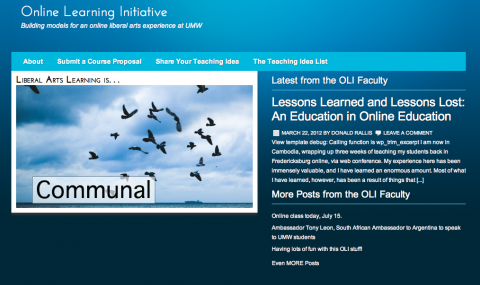 UMW’s Online Learning Initiative, amongst other things, worked to organize and formalize some of the amazing digitally-based work happening at UMW into a foundation for an approach to teaching fully online courses across the disciplines. This practice was very much driven to apply the principles of a liberal arts education to web-based learning, i.e., community, interaction, collaboration, etc. Given all the digital work done over the years at UMW, this initiaitve was in a unique position to design and teach courses which instill the values of a liberal arts & sciences experience into a fully online environment that are comparable in quality and social impact as ou traditional face-to-face courses..
Link to an archived version of the Online Learning Initaitive site.
University of Mary Washington Blogs
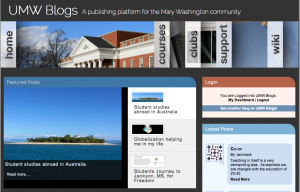 This project, now retired, was run on WordPress Multi-Site (an open source semantic publishing platform) that enabled students and faculty to author online with minimal overhead. This was the second iteration of a multi-user blogging platform (see the ELS Blogs description below for the first) and it was freely available campus-wide to any UMW faculty, staff or student who wanted to use it.
In its heyday it experienced precipitous growth, going from thirteen hundred student and faculty sites during the Fall 2007/Spring 2008 semesters to 6800 sites in Spring 2012. This web-based publishing space offered the UMW academic community a quick and easy authoring solution that was flexible, elegant, and open. What's more, it was both scalable and sustainable in that it provided a self-service means for creating class sites, e-portfolios, and a whole host of other web-based resources.